
ANATOMY AND EVOLUTION
The term “neo” derives from the Greek translation to “new,” fittingly named as this class is thought to have appeared recently in terms of vertebrate evolution. It comprises the outermost layer of the cerebral hemispheres and is divided into six distinct layers, each serving a specialized function. The neocortex is the primary component in higher-order brain functions, and exploring the layers' functional architecture can help us understand behaviours, survival strategies and cognition in mammals.
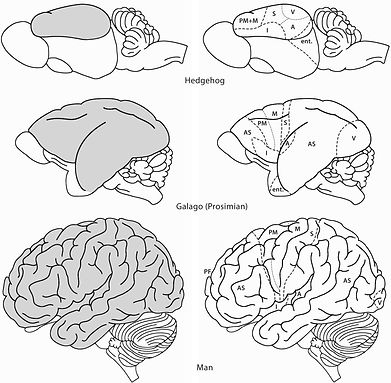
Although brain tissue is too soft to fossilize, records of the brain and early variations of the neocortex can be obtained through fossilized skull and brain casings using endocasts. This technique uses the cranial structure to cast the cranial cavity, thus providing a 3D structure which can then be used to determine the brain's weight, approximate size, and surface composition.
The first records of a neocortex are from the synapsid, through a small portion of their dorsal cortex (which can still be found in certain reptiles today!) The neocortex of these early mammals contained six layers of cells, with a dorsal spine consisting of pyramidal neurons and occasional smaller, inhibitory neurons. These neurons take synaptic inputs and turn them into patterns of output action potential. The six layers, the cortical area, primarily provided sensory and limited motor behaviour functions.
Early mammals were relatively small and had little to no neocortex; the brain was primarily composed of the olfactory bulb, representing the sense of smell essential for survival. The neocortex continued to evolve through divergent evolution over 200 million years, creating a cascade of developmental factors. An increase in neocortex size allowed for an increase in cortical areas, resulting in functional specialization and an increase in cognitive abilities.
In today's mammals, the neocortex and focal structures vary in size and shape across all phylogenetic mammal groups, with the primary structure remaining consistent among all mammalian species.
EVOLUTION
NEOCORTEX LAYERS TAXONOMY AND FUNCTION
fig. 1: Lateral views of particular mammalian brains represent the evolution of the neocortex (grey). The hedgehog's neocortex occupies its sensory and motor sections, whereas in the galago, the sensory areas are separated by an association complex. A second association complex is noted in front of the motor areas.
In man (human), the posterior and anterior association areas are well developed.
Association areas makeup a large portion of the cortex, integrating incoming sensory information, and forming connections between motor and sensory areas.

The neocortex is also comprised of four regions (frontal, parietal, occipital, and temporal lobe) based on patterns of grooves (sulci) and ridges (gyri), which are created to create a larger surface area to allow for more neural components.

Layer 1: The molecular layer comprises axons and dendrites and contains a minimal number of neurons. This is the most superficial layer, and its function is to receive input from other cortical layers and a site for synaptic connections.
Layer 2 + 3: External granular layer + External pyramidal layer. Normally considered one layer, comprised of less dense cells that project to other areas of the neocortex. Both serve the function of processing sensory information.
Layer 4: Internal granular layer. Receives cortical input from the thalamus and relays it to higher sensory areas such as the visual and auditory cortex.
Layer 5: Internal pyramidal layer contains the largest neural cells that project motor neurons to the motor cortex for movement and cognitive function.
Layer 6: Fusiform or multiform layer provides feedback to the thalamus.